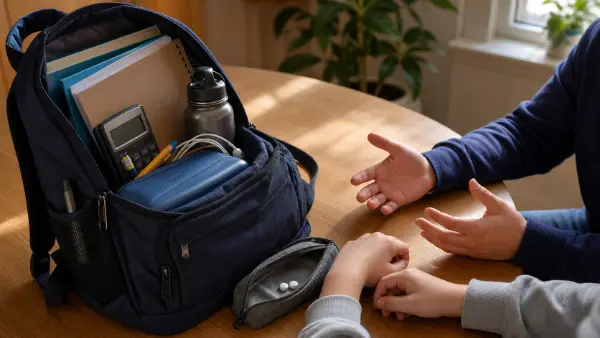
Back to school: What’s in your child’s backpack?
As students return to school, parents may be thinking about more than notebooks and lunchboxes. Alcohol, cannabis and nicotine products remain concerns—but prevention begins with accurate information, not suspicion.
The desire to fit in is one reason young people may experiment with substances. Other reasons include curiosity, stress, emotional distress and the desire to feel good or improve performance. Alcohol, tobacco and marijuana are among the substances most commonly used by young people.
In a 2025 national survey, 41% of 12th-graders reported drinking alcohol, 26% reported using cannabis and 20% reported vaping nicotine during the previous 12 months. Those rates were statistically unchanged from 2024 and remained near historically low levels.
The figures describe any reported use during the preceding year. They do not show how many students used substances at school or carried them in backpacks.
Still, concealment is a legitimate concern. Federal regulators have warned about unauthorized e-cigarettes designed to resemble everyday products, including toys and drink containers. Such designs may help young people hide the devices from adults. Parents should familiarize themselves with vaping products and school policies without treating every unfamiliar item as proof of substance use.
Counterfeit pills present a different—and potentially fatal—risk. Illicit pills may resemble medications such as oxycodone, Xanax or Adderall while containing fentanyl or methamphetamine. Medications should be taken only when prescribed by a trusted medical professional and obtained from a licensed pharmacy.
Substance use can also affect students’ safety and readiness to learn. Research has found an association between alcohol-related behaviors and lower grades, although the findings do not prove that one causes the other.
Prevention starts with ongoing, two-way conversations. Parents should speak directly and honestly, listen without immediately lecturing and clearly explain family expectations. They can ask what their children have seen or heard, discuss how to respond to peer pressure and make sure their children know they can call for help without fear.
If an opioid overdose is suspected, give naloxone if it is available, call 911 and remain with the person until help arrives.
 News Staff
 -
-
alcohol
cannabis and nicotine
-
59 views -
0 Comments -
0 Likes -
0 Reviews
-
-
alcohol
cannabis and nicotine
-
59 views -
0 Comments -
0 Likes -
0 Reviews