-
3.4K Views 0 Comments 0 Likes
DLNews Politics:
Funding the Proposed $1.5 Trillion U.S. Military Budget: Mechanisms and Trade-Offs
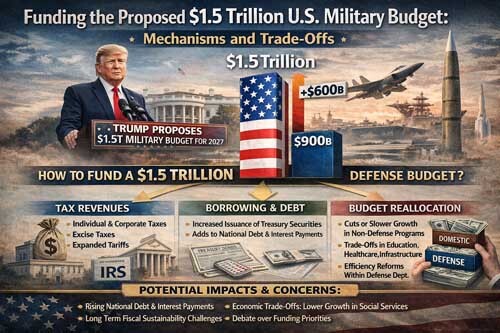
President Trump's January 7, 2026, proposal to raise the U.S. military budget to $1.5 trillion for fiscal year 2027 represents a substantial increase from the current baseline of approximately $900 billion. This scale of expansion raises practical questions about how such spending would be financed and what domestic priorities might be affected.
The U.S. federal budget relies on a combination of tax revenues, borrowing, and reallocations within existing funds. Without new dedicated revenue sources explicitly tied to the increase, funding would likely draw from these established channels. General tax receipts—including individual income taxes, corporate taxes, and excise taxes—form the primary revenue base. Some analyses suggest that expanded tariffs on imports could generate additional funds, as tariff collections have historically ranged in the tens to hundreds of billions annually depending on policy scope. Economic growth stimulated by defense contracts could also indirectly boost revenues through higher employment and corporate profits in related sectors.
A significant portion would probably be covered through borrowing, as the government issues Treasury securities to cover deficits. Fiscal projections indicate that sustained spending at this level, if not offset by equivalent revenue growth or cuts elsewhere, could substantially increase the national debt and future interest payments. Historical patterns show that large defense increases often contribute to higher deficits, with potential long-term effects on interest rates and inflation.
Reallocation within the federal budget remains another key mechanism. Defense already consumes over half of discretionary spending, leaving limited room for growth without impacting non-defense areas. Trade-offs could involve slower growth or reductions in programs such as education, healthcare initiatives, infrastructure development, scientific research, and social services. Economic studies consistently find that defense spending creates fewer jobs and lower growth multipliers per dollar compared to investments in education, health, or infrastructure, meaning shifts toward military outlays can have opportunity costs for broader economic productivity.
Professional recommendations for managing such an increase emphasize fiscal responsibility. Options include procurement reforms to eliminate waste and overruns, which could save substantial sums without reducing capabilities. Revenue-neutral approaches, such as closing tax loopholes or implementing targeted efficiencies, could help avoid sharp debt increases. Strengthening international burden-sharing through alliances—where partners contribute more to shared security goals—offers another way to maintain deterrence while moderating unilateral U.S. costs. Dynamic budgeting that aligns spending growth with overall economic expansion is also frequently advised to preserve balance across priorities.
In essence, funding a $1.5 trillion defense budget is feasible through existing fiscal tools, but it would require careful navigation of trade-offs. The choices made during Congressional review and appropriations would ultimately determine the distribution of impacts across government functions and the long-term health of public finances.

Queue

Desert Local News delivers sharp, fact-checked coverage from the Coachella Valley to the world — local stories, business, entertainment, opinion, global headlines, and the unexpected moments that keep things interesting.