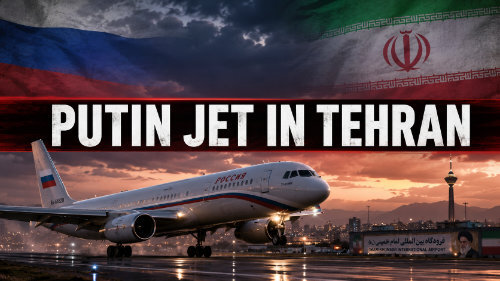
Putin’s Command Jet Lands in Tehran
Russia has sent a highly specialized government command aircraft to Iran, offering a visible sign of Moscow’s continuing support for Tehran as the Iranian leadership faces renewed military pressure from the United States.
A Russian Tupolev Tu-214PU departed Moscow and landed at Tehran’s Imam Khomeini International Airport on Monday. The aircraft belongs to Russia’s Special Flight Squadron, which transports senior officials and operates planes equipped for sensitive government missions.
The purpose of the flight has not been publicly confirmed by either the Kremlin or the Iranian government. There is therefore no verified evidence that the aircraft carried weapons, military equipment or direct operational assistance.
Its arrival, however, is significant because the Tu-214PU is not an ordinary passenger jet. The letters “PU” refer to the Russian term for a command post. The aircraft is fitted with secure communications equipment that allows senior officials to remain connected with government and military leadership during emergencies.
The Tu-214PU is approximately 151 feet long, normally cruises at about 528 mph and has a reported range of roughly 4,000 miles. Only a small number of the specialized aircraft are believed to be operated by Russia, and their passenger lists and missions are rarely disclosed.
Although frequently described in news reports as a “doomsday plane,” the Tu-214PU is not Russia’s principal nuclear-war command aircraft. That role is associated with the larger Ilyushin Il-80, Russia’s counterpart to the U.S. Air Force’s Boeing E-4B Nightwatch.
The Tu-214PU is more accurately described as a secure airborne command and government communications aircraft designed for high-level crisis operations.
The flight comes as Russia and Iran deepen a relationship built partly around their shared opposition to Western sanctions and American influence. Presidents Vladimir Putin and Masoud Pezeshkian signed a 20-year comprehensive strategic partnership agreement in January 2025.
The agreement provides for closer defense cooperation, military exercises, intelligence sharing and coordination against common threats, but it stops short of requiring either country to defend the other militarily.
That distinction is important. The aircraft’s presence in Tehran does not prove that Putin has entered the conflict or ordered Russian forces to assist Iran. It could have transported diplomats, security officials, communications specialists or members of a high-level delegation.
Nevertheless, dispatching one of Russia’s most secure government aircraft during a period of intense confrontation sends a clear political message. Moscow wants Iran’s clerical leadership, and its adversaries, to know that Tehran is not entirely isolated.
The flight may ultimately prove to have been diplomatic rather than military. But at a moment when Iran’s rulers are under pressure, the appearance of a Russian flying command post in Tehran demonstrates that Putin continues to view the survival of the Iranian government as an important Russian strategic interest.