Canada Tariffs Raise the Stakes
The trade relationship between the United States and Canada has entered one of its most serious periods in decades — and the consequences could reach far beyond factories and border crossings, potentially affecting American consumers, businesses and even tourism-dependent communities such as Greater Palm Springs.
Canada announced Tuesday that beginning September 8 it will impose tariffs of 15%, 25% and 50% on roughly 700 categories of American products representing C$27.6 billion — about US$20 billion — in imports. The targets include steel, aluminum, dairy products, appliances, agricultural equipment, pulp and paper products, electronics and other manufactured goods. Ottawa says the tariffs are designed to match recently imposed U.S. duties dollar for dollar.
Canada is also providing C$7.5 billion in assistance to businesses and workers affected by the widening dispute. Canadian officials have made clear that the purpose of the tariffs is not simply to collect money: they were selected partly to reduce dependence on American suppliers and to put economic and political pressure on U.S. industries and states.
For Americans, the immediate danger is lost business. When Canada adds a 25% or 50% tariff to an American product, that product becomes substantially more expensive for Canadian buyers. Canadian retailers and manufacturers may respond by purchasing domestically or turning to suppliers in Europe, Asia or elsewhere. That can mean fewer orders for U.S. factories, farms and manufacturers.
The scale of the overall relationship makes any prolonged confrontation significant. U.S. goods exports to Canada totaled about $333.6 billion in 2025, while imports totaled approximately $381.9 billion. Canada has consistently ranked among America's two largest trading partners, and the two economies are especially intertwined in automobiles, energy, agriculture and manufacturing.
Why fight with one of America's closest neighbors?
The dispute did not begin with Tuesday's Canadian announcement.
The Trump administration argues that Canadian policies have discriminated against American products, particularly automobiles, dairy products and alcoholic beverages. The White House used Section 338 of the Tariff Act of 1930 to impose additional duties of as much as 50% on certain Canadian goods. Washington says the action is intended to force more equal treatment of American exports.
Canada disputes the U.S. approach and says Washington is using tariffs to extract concessions that Ottawa considers unacceptable. Negotiations came close enough to an agreement that the White House temporarily delayed some tariffs for three days, but the talks ultimately collapsed and the new U.S. duties took effect August 22.
That leaves two countries whose factories, energy systems and supply chains were built around decades of relatively free cross-border trade now deliberately putting barriers in each other's way.
And it could get worse.
President Trump has threatened to raise tariffs on Canadian-made cars, trucks and auto parts to 50% beginning January 1, 2027 if there is no agreement. Canadian officials, meanwhile, have discussed possible restrictions involving electricity, energy, potash and critical minerals, although those measures have not been implemented as part of the September 8 package.
Electricity is not an empty threat. Ontario briefly imposed a 25% surcharge on electricity exports to Michigan, Minnesota and New York in March 2025 before suspending it. Ontario estimated the surcharge could have affected 1.5 million American homes and businesses.
For U.S. consumers, escalation would arrive at an uncomfortable time. Consumer prices were already 3.4% higher in July than a year earlier. Gasoline was up 24.6%, while electricity prices were 4.2% higher. Tariffs on imported materials, vehicles or other Canadian goods could add further pressure because tariffs are collected from U.S. importers, who may pass some or all of that additional cost to customers.
Why Greater Palm Springs should pay attention
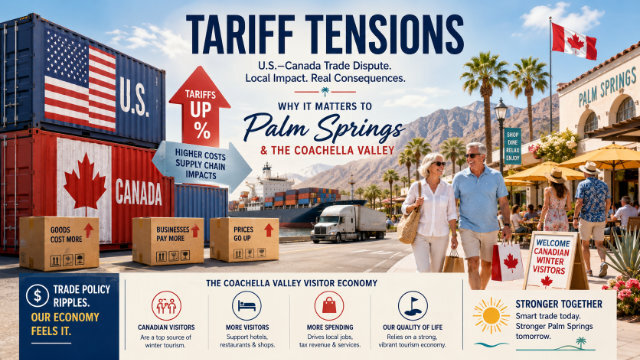
For the Coachella Valley, the larger concern may not be steel or machinery. It is Canadians themselves.
Greater Palm Springs welcomed about 15 million visitors in 2025, generating an estimated $9.6 billion in total economic impact. Tourism supports roughly one in every four local jobs, making the region particularly sensitive to changes in visitor confidence and spending.
Canadians are a particularly visible part of the winter economy. More than 300,000 Canadians have been estimated to visit or reside seasonally in the Palm Springs area annually, and Palm Springs International Airport has direct seasonal Canadian connections including Calgary, Edmonton, Toronto, Vancouver and Winnipeg.
There are already warning signs nationally. During the first quarter of 2026, Canadian visits to the United States fell 10.6% from a year earlier and Canadian spending in the U.S. dropped 13.6%. Travel began recovering later in the year, but June trips were still nearly 25% below June 2024 levels. Canadian air arrivals into California were down another 2.3% year over year in July.
That does not mean Canadian tourism to Palm Springs is about to disappear. But another round of hostile rhetoric, higher prices or economic uncertainty could convince some snowbirds to shorten stays, spend less or choose Mexico, Europe or destinations within Canada instead.
For hotels, restaurants, golf courses, retailers, vacation rentals and service businesses from Palm Springs and Palm Desert to Indian Wells and La Quinta, even a relatively modest reduction in Canadian winter spending could be noticeable.
The greatest danger, therefore, is not one tariff taking effect September 8. It is escalation.
The United States and Canada built one of the world's largest trading relationships precisely because their economies complement each other. A prolonged tariff war can certainly hurt Canada — whose economy is more dependent on the American market — but the United States is not insulated from the consequences.
When neighbors this economically intertwined begin deliberately making each other's products more expensive, there are rarely winners. American businesses, consumers and tourism communities could ultimately end up paying the price.
 News Staff
 -
-
Business
United States and Canada Tariffs
-
63 views -
0 Comments -
0 Likes -
0 Reviews
-
-
Business
United States and Canada Tariffs
-
63 views -
0 Comments -
0 Likes -
0 Reviews






 Loading ...


