Press Ban Tests the Constitution
Legal analysis | September 19, 2026
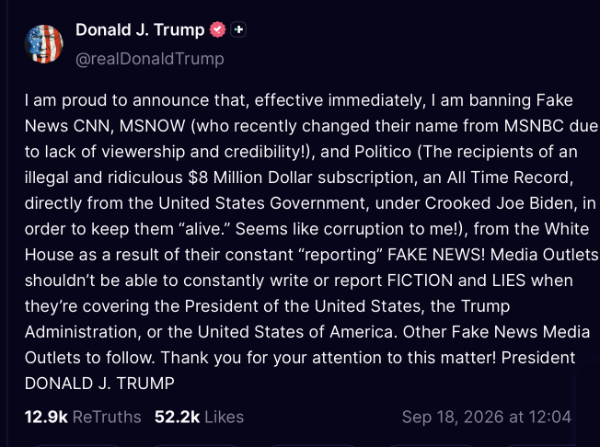
WASHINGTON — The confrontation reached the White House checkpoint. Reporters from CNN, MS NOW and Politico were denied entry Saturday, with press credentials deactivated or confiscated, according to the news organizations. Among those affected were CNN’s Betsy Klein, MS NOW’s Akayla Gardner and Politico’s Cheyenne Haslett. President Donald Trump’s announced ban had become an obstacle to doing their jobs.
Trump announced the exclusions Friday, accusing the outlets of spreading “fake news” and indicating that others could follow. He attributed the decision to accumulated coverage over years rather than one particular report.
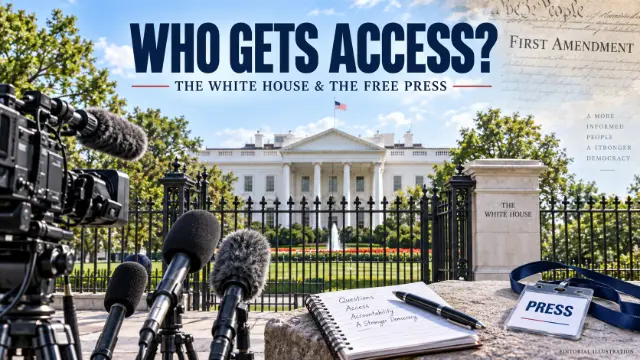
The constitutional question is whether the administration can withdraw established press access because it objects to what journalists publish.
The White House’s status as the people’s house does not give everyone an unrestricted right to enter. It is a secured workplace and presidential residence. Journalists have no automatic entitlement to an interview, a place aboard Air Force One or admission to every meeting.
However, opening press facilities to eligible journalists creates constitutional obligations. In Sherrill v. Knight, the federal appeals court in Washington ruled in 1977 that access could not be denied arbitrarily or without compelling reasons. Protecting the president was a legitimate concern, but credentialing decisions required meaningful standards and procedural safeguards.
That distinction puts Trump’s stated reason under scrutiny. A documented security threat and dissatisfaction with coverage present different legal questions.
“A ban like this would be flatly unconstitutional,” said Bruce D. Brown, president of the Reporters Committee for Freedom of the Press. His organization characterized the announced exclusions as viewpoint discrimination: government penalizing speakers because of their editorial perspective. That is the organization’s legal assessment; it is not a court judgment resolving these new lockouts.
The Fifth Amendment also matters. Sherrill required notice of the reasons for denial, an opportunity to respond and a written decision. A constitutional challenge could therefore examine both why credentials were withdrawn and whether reporters received an adequate process for contesting that action.
Recent litigation illustrates why the outcome should not be presented as automatic. In 2025, the Associated Press challenged restrictions imposed after it continued using “Gulf of Mexico.” A district judge granted an injunction, but the appeals court subsequently stayed much of that relief, allowing restrictions involving limited presidential spaces to continue during the appeal. Those proceedings demonstrate that the location and kind of access matter; general press credentials and admission to restricted events are not interchangeable.
The phrase “fake news” does not settle any of those questions. It can describe fabricated material presented as reporting, but it can also be used loosely to attack mistakes, disputed interpretations or unwelcome coverage. Calling something false does not establish that it is false.
Consider a hypothetical example. A government report says a bridge project increased in cost from $100 million to $125 million. A newspaper accurately reports a 25% increase. Officials may believe its headline ignores valuable improvements, but that disagreement does not make the arithmetic fabricated. An editorial calling the increase wasteful offers an assessment. Inventing a nonexistent audit that accuses an official of stealing the additional money would be a different matter entirely.
Constitutional protection also does not disappear whenever a statement contains an error. In United States v. Alvarez, the Supreme Court rejected the proposition that false statements, simply because they are false, fall wholly outside the First Amendment. Particular categories, including defamation and fraud, remain subject to legal rules.
For a public official seeking damages over defamatory reporting about official conduct, New York Times v. Sullivan requires proof of “actual malice”: knowledge of falsity or reckless disregard for truth, along with the other elements of the claim. The term concerns the publisher’s awareness of truth or falsity; an unfriendly tone alone does not establish it.
For the affected newsrooms, the response has two tracks: contest the restrictions and continue reporting. CNN, MS NOW and Politico have pledged to defend their rights and maintain coverage. Their statements should not be confused with confirmation that a particular lawsuit has already been filed.
Available legal steps include seeking an emergency court order restoring access and challenging the exclusions under the First and Fifth Amendments. Other news organizations can support litigation through friend-of-the-court briefs, as dozens did in the AP dispute. Such filings allow competitors to defend a shared newsgathering interest without endorsing one another’s reporting.
Journalists can also continue examining government actions through interviews, documents, court records and reporting outside the White House. Those methods remain essential, although they cannot fully replace the opportunity to witness an event directly or ask a timely follow-up question.
The final legal authority rests with the courts. In a lawsuit, federal judges determine whether the government’s conduct complies with the Constitution. A district court can issue an initial order, an appeals court can review it, and the Supreme Court can provide the final judicial ruling if it takes the case. If it declines review, the lower court’s judgment ordinarily remains in place.
For readers, the stakes extend beyond which reporter gets through a gate. Sherrill recognized that the public itself has a First Amendment interest in protecting newsgathering against arbitrary exclusions. The dispute concerns how independently Americans can learn what their government is doing—and the constitutional limits on officials controlling that access.
 News Staff
 -
-
Other
Whitehouse
Washington DC
First Amendment
Press-ban CNN
MS NOW and Politico
-
71 views -
0 Comments -
0 Likes -
0 Reviews
-
-
Other
Whitehouse
Washington DC
First Amendment
Press-ban CNN
MS NOW and Politico
-
71 views -
0 Comments -
0 Likes -
0 Reviews




 Loading ...


