 News Staff
 -
Thu at 8:13 PM -
Russia
NATO
Baltic Sea
Kaliningrad
Nuclear Response
-
77 views -
0 Comments -
0 Likes -
0 Reviews
-
Thu at 8:13 PM -
Russia
NATO
Baltic Sea
Kaliningrad
Nuclear Response
-
77 views -
0 Comments -
0 Likes -
0 Reviews
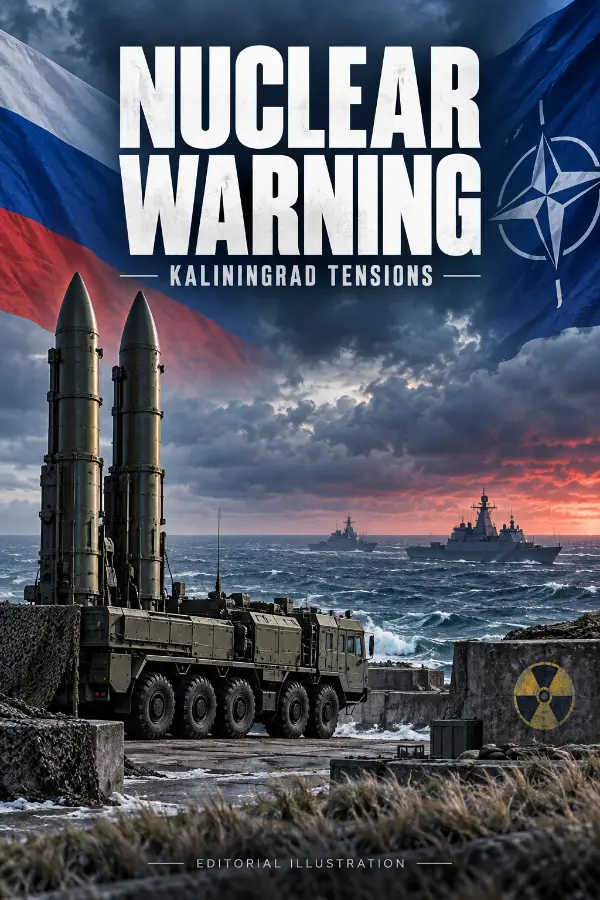
Russia’s Nuclear Warning Over Kaliningrad
A small Russian territory on the Baltic Sea has become the focus of a threat with consequences far beyond its borders. Moscow has warned NATO that attempts to cut off Kaliningrad could bring a nuclear response, sharpening fears of a direct confrontation between Russia and the Western alliance.
Russian President Vladimir Putin reinforced that warning on Thursday, October 1, 2026. Speaking at the Valdai Discussion Club in Moscow, he said a direct attack on Kaliningrad would immediately raise the question of using every weapon Russia possesses. He also said Russia had no plans to attack European countries. His remarks underscored the danger while stopping short of announcing military action.
The warning followed a Russian diplomatic document sent to NATO and reviewed by Reuters. It accused the alliance of pursuing a “dangerous and reckless course” and threatened possible strikes against “decision-making centers” in member countries. Moscow explicitly included nuclear weapons among its possible responses to efforts to isolate the territory.
NATO rejected the premise. Spokeswoman Allison Hart confirmed that the alliance had received the informal diplomatic communication, known as a non-paper, and replied that its activities posed no threat to Russian territory.
“We strongly denounce the threat of force, including any irresponsible nuclear rhetoric,” Hart said. She added that NATO would continue supporting Ukraine and remained prepared to defend allied territory.
Kaliningrad’s geography helps explain its sensitivity. Separated from mainland Russia and bordered by NATO members Poland and Lithuania, it houses Russia’s main Baltic naval base and nuclear-capable Iskander missiles. That capability does not, by itself, establish that the missiles are currently armed with nuclear warheads.
The distinction between a protective naval mission and a blockade is central to the dispute. NATO launched Baltic Sentry in January 2025 to help protect underwater infrastructure after damage to energy and communications cables. Its announced assets included frigates, maritime patrol aircraft and naval drones. NATO’s published purpose was infrastructure security; that does not substantiate Moscow’s allegation that the alliance is preparing to isolate Kaliningrad.
The possibility of nuclear escalation must be taken seriously, but the public statements do not establish that a launch decision has been made or that an attack is imminent. They also provide no credible basis for assigning a numerical probability.
One possible route toward escalation is miscalculation: an action intended as limited pressure could be interpreted as the opening of a wider conflict. Nuclear analyst and former Russian diplomat Nikolai Sokov warned Reuters of precisely that danger, particularly over how Moscow might interpret a blockade.
An armed attack on Poland, Lithuania or another ally could bring NATO’s collective-defense obligations into play. Under Article 5, members must assist an attacked ally, but each determines the action it considers necessary. The treaty does not automatically require a nuclear response.
Deterrence remains a substantial barrier to escalation. NATO says its nuclear forces exist to prevent coercion and aggression, and describes the circumstances in which it might use them as extremely remote. That policy is intended to discourage an attack; it cannot eliminate the possibility of a disastrous judgment.
For ordinary Europeans, the nearer concern may be disruption below the threshold of open war. Belgian Defense Minister Theo Francken warned on September 30 of a “dark winter” of further hybrid attacks. Speaking at the Euronews Defence Summit, he pressed for stronger defenses as Belgium faced drone incidents, some of which had disrupted air traffic.
The nuclear language demands attention. The crucial question now is whether governments can prevent threats, military encounters and competing interpretations of defensive action from becoming a conflict nobody can reliably contain.

Queue

Desert Local News delivers sharp, fact-checked coverage from the Coachella Valley to the world — local stories, business, entertainment, opinion, global headlines, and the unexpected moments that keep things interesting.

 Loading ...
