 News Staff
 -
10 hours ago -
AI
“White House Accord on Super Intelligence”
proofreader
-
60 views -
0 Comments -
0 Likes -
0 Reviews
-
10 hours ago -
AI
“White House Accord on Super Intelligence”
proofreader
-
60 views -
0 Comments -
0 Likes -
0 Reviews
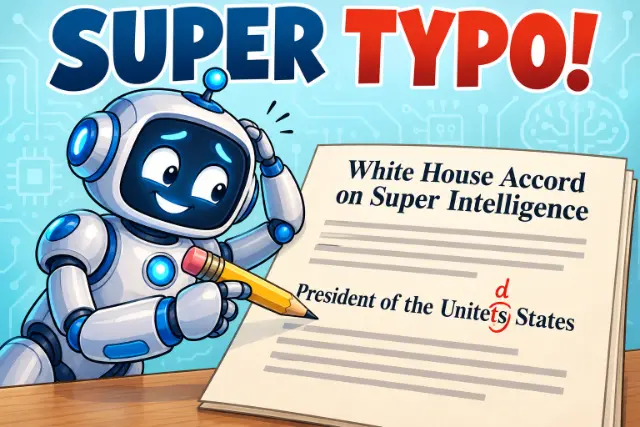
Super Intelligence, Basic Typo
Satirical commentary
WASHINGTON — Before artificial intelligence takes over the world, perhaps someone could ask it to read the last line.
President Donald Trump and six leading technology executives signed the “White House Accord on Super Intelligence” on September 29, promising safeguards for increasingly powerful AI. Beneath Trump’s signature, the published document identified him as “President of the Unites States.” (It should read “President of the United States.”)
One small letter for a proofreader. One giant headache for the branding department.
The contrast was almost unfair to professional comedians: a document announcing super intelligence, endorsed by people building the technological future, stumbling over the name of the country hosting the meeting.
The signers included Google’s Sundar Pichai, Anthropic’s Dario Amodei, Meta’s Mark Zuckerberg, OpenAI’s Greg Brockman, Nvidia’s Jensen Huang and Elon Musk. That is a formidable collection of technological expertise to assemble around a document that could have benefited from one slightly cranky copy editor.
To be fair to Trump, the mistake appeared in the printed title beneath his signature. That does not establish that he typed it, dictated it or personally sent the letter “d” into early retirement. Nor does the published error tell us which signers actually read that line.
It does establish that the typo survived publication. Trump shared the document on Truth Social, and the White House posted it on X. The error therefore enjoyed something approaching a coordinated communications rollout.
Behind the comedy was a serious undertaking. The voluntary accord called for internal safeguards, monitoring teams, independent outside evaluations and board-level oversight of advanced AI. For people wondering whether powerful systems can be trusted, those commitments deserve scrutiny beyond the signature page.
Still, promising multiple layers of oversight while publishing “Unites States” is an awkward opening demonstration.
Trump described the agreement as “morally binding” and said, “It’s almost like a constitution in a way.”
Almost. Constitutional ambition, first-draft finish.
A typo does not prove the safeguards are worthless. Anyone who publishes anything eventually discovers that an embarrassing mistake has excellent survival instincts. But when the sales pitch is super intelligence, ordinary proofreading becomes a reasonable customer expectation.
And there is one final wrinkle: “unites” is a real word. A basic spellchecker might accept it. Catching the mistake requires context — precisely the sort of understanding the AI industry is so eager to sell.
Perhaps the next summit could begin with a modest challenge: find the wrong word before tackling the future of humanity.
No breakthrough required. Just read to the bottom.

Queue
Desert Local News delivers sharp, fact-checked coverage from the Coachella Valley to the world — local stories, business, entertainment, opinion, global headlines, and the unexpected moments that keep things interesting.

 Loading ...
