DLNews Politics -Business
Tariffs, Triggered: Supreme Court Limits Trump’s Emergency Trade Powers
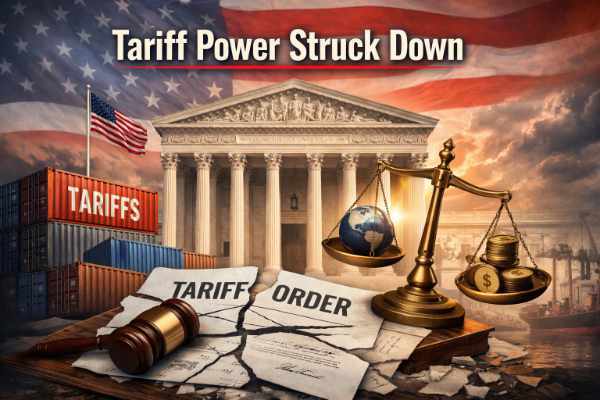
In a major decision reshaping presidential trade authority, the U.S. Supreme Court ruled 6–3 that President Trump’s sweeping tariffs imposed during his second term under emergency powers were unlawful. The Court found that the statute relied upon — the International Emergency Economic Powers Act (IEEPA) — does not clearly authorize a president to impose broad, worldwide tariffs without congressional approval.
The ruling is a significant constitutional moment. The majority opinion emphasized that tariffs function as a form of taxation, and under the Constitution, Congress — not the executive branch — holds primary authority over taxes and trade regulation. The decision does not eliminate presidential tariff power altogether, but it restricts the use of emergency authority as a shortcut.
What changes immediately — and what does not — is critical.
The ruling applies specifically to tariffs imposed under IEEPA. It does not automatically erase other tariffs that were implemented under separate legal authorities, such as national security provisions (Section 232) or trade enforcement statutes (Section 301). Those tariffs remain in effect unless separately challenged or modified.
In practical terms, this means some tariff collections tied directly to the emergency authority should cease. However, the broader U.S. tariff structure remains largely intact for now.
The most pressing question involves money already collected.
The Court did not decide whether the federal government must return billions of dollars in tariff revenue already paid by importers. That issue is likely to be resolved through additional litigation in the U.S. Court of International Trade and through administrative customs processes.
Historically, if tariffs are invalidated, refunds — when issued — are paid to the importers of record, not directly to consumers. That distinction matters. Tariffs are paid at the border by companies importing goods. Retail “tariff surcharges” passed along to customers are pricing decisions made by businesses. There is no automatic federal mechanism requiring retailers to reimburse consumers for past price increases.
For consumers in the Coachella Valley and greater Palm Springs area, the impact is likely to be gradual rather than dramatic. If certain imported goods become cheaper going forward — appliances, building materials, restaurant equipment, auto parts — local businesses could see some cost relief. Whether those savings reach customers will depend on competition, inventory timing, and market conditions.
This ruling is less about immediate price drops and more about constitutional boundaries. The Supreme Court did not end tariffs. It ended a particular method of imposing them. Any future tariff actions will likely require more formal investigation, congressional alignment, or narrower statutory justification.
The economic consequences will unfold case by case, invoice by invoice. And for now, the biggest shift is not at the checkout counter — but in the balance of power between Congress and the White House.
 News Staff
 -
-
Business
congress
Supreme Court
Tariffs war
IEEPA
-
62 views -
0 Comments -
0 Likes -
0 Reviews
-
-
Business
congress
Supreme Court
Tariffs war
IEEPA
-
62 views -
0 Comments -
0 Likes -
0 Reviews