U.S. Sanctions Nearly 60 Iran-Linked Targets
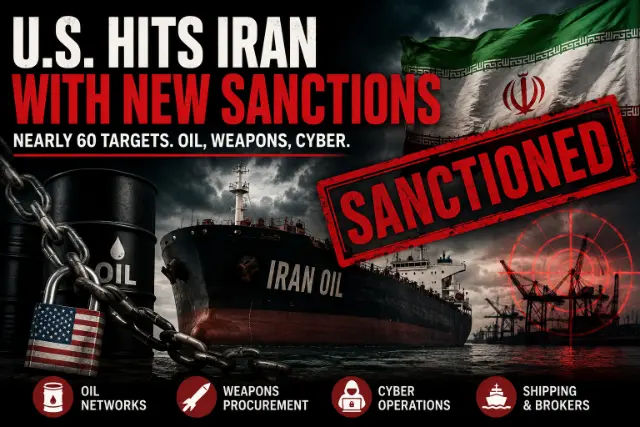
WASHINGTON — The United States has imposed a sweeping new round of sanctions against nearly 60 people, companies and vessels accused of helping Iran obtain sensitive technology, conduct cyberoperations and move oil through international markets.
Treasury Secretary Scott Bessent announced the action on Aug. 24 as part of what the administration calls Operation Economic Outcast, an effort aimed at increasing financial pressure on Tehran and the international networks that continue doing business with sanctioned Iranian organizations.
The Treasury Department describes the package as targeting “nearly 60 entities, individuals, and vessels.” The sanctions reach well beyond Iran, touching networks operating in China, Hong Kong, Singapore, Malaysia, the United Arab Emirates, Switzerland, France, the United Kingdom and other jurisdictions.
The administration also expanded the sectors of Iran’s economy that can expose foreign companies and financial institutions to U.S. sanctions. Those sectors now include digital assets, technology, gold, aviation and shipping.
The broader message is clear: Washington is targeting not only Iranian institutions, but also foreign businesses, brokers, shipowners and intermediaries that U.S. officials say help Tehran obtain equipment, sell petroleum or move money.
Nuclear and Defense Procurement
One major part of the sanctions focuses on an international procurement network that Treasury says acquired sensitive and dual-use equipment for Iranian organizations associated with defense and weapons research.
At the center of that network is Sweet Ocean Industrial Limited, a Hong Kong company accused of procuring equipment, including laser-optics technology, for Iran’s sanctioned Malek Ashtar University of Technology.
The procurement-related targets include:
1. Sweet Ocean Industrial Limited
2. Li Na
3. Tian Jianbai
4. Zhang Limei
5. RPT Technology Limited
6. Shenzhen Sweet Ocean Technology Limited
7. Tiany Technology Limited
8. MT Trading and Logistics HK Limited
9. Feili Co Limited
10. Minvur Limited
11. Feisu Limited
12. Guska Co Limited
13. Vast Mart SDN BHD
14. HK Jiatai Technology Limited
15. DEC Photonics Limited
16. Noavaran Axis Private Joint Stock Company, also known as BRE Line
17. Mohammad Hossein Aslani Moghaddam
18. Shenzhen Huamei Lianyun International Logistics Co Ltd
19. BRE International Logistics Corporation HK Limited
20. Qiu Xingyu
21. Shenzhen Bositong Logistics Co Ltd
22. Bositong Supply Chain Shenzhen Co Ltd
Treasury says BRE Line facilitated shipments connected to Iran’s Organization of Defensive Research and Innovation, known as SPND, which operates under Iran’s Ministry of Defense and has previously been sanctioned by the United States.
U.S. officials allege that companies and individuals across the network helped arrange purchases, payments, transportation and logistics for equipment ultimately destined for Iranian organizations.
Iranian Cyberoperators
The sanctions also target five Iranian nationals whom the Treasury Department says participated in cyberoperations linked to Iran’s Ministry of Intelligence and Security.
The five are:
23. Mojtaba Ghal’eh-Kuhi
24. Keyvan Fayyaz Ghareh Blagh
25. Saber Shahbazi Balujeh
26. Mohammad Reza Kadkhoda’i
27. Arman Kahzadian
U.S. authorities accuse members of the network of targeting organizations in the energy, defense, health care, information technology and financial sectors, as well as government agencies.
Treasury also alleges that some participants stole cryptocurrency and other valuable information.
Because these allegations come from U.S. government sanctions findings rather than criminal convictions in every case, they are appropriately described as accusations or findings by the Treasury.
Oil Brokers and Shipping Networks
Another major portion of the sanctions focuses on the complicated international system used to transport Iranian crude oil and petroleum products despite existing U.S. restrictions.
Treasury identified Syrian national Mohammad Ahmed Suhil Fattouh, also known as “Captain Hamzah,” as a broker who allegedly helped arrange vessels for Iranian oil shipments.
Ukrainian national Ivan Obukhov, based in the UAE, is accused of helping arrange Iranian oil shipments and processing large cryptocurrency payments linked to petroleum sales benefiting Iran’s Islamic Revolutionary Guard Corps-Qods Force.
Singapore-based Azure Shipping PTE. LTD. was also sanctioned. Treasury says the company worked with the National Iranian Tanker Company and provided ship-to-ship services involving sanctioned vessels.
The oil and shipping facilitators named include:
28. Mohammad Ahmed Suhil Fattouh
29. Amdeh Ship Management and Operation Co. L.L.C
30. Ivan Obukhov
31. Foscom FZE
32. Azure Shipping PTE. LTD.
33. Mansoor Tayabbhai Gandhi
34. Arc Chartering Pte. Ltd.
35. Sky Oil and Gas Asia Limited
36. Shipoil Limited
37. Shipoil FZCO
38. Ship Fuels and Trade DMCC
39. Almpertos “Alberto” Tsoris
40. Georgios “George” Tsoris
41. Good Luck Shipping LLC
42. Unique Oasis Shipping Services LLC
43. Target Horizon Shipping LLC
Treasury says companies within the Shipoil network provided fuel and other services to vessels involved in transporting Iranian crude and petroleum products.
The use of brokers, shell companies, ship-to-ship transfers and companies registered in multiple jurisdictions has become a central issue in Washington’s effort to restrict Iran’s petroleum exports.
The Wellbred Network
The sanctions also reached an international commodities trading network that Treasury says is connected to Iranian shipping figure Mohammad Hossein Shamkhani.
Four companies were targeted:
44. Wellbred Capital PTE. LTD. — Singapore
45. Wellbred Trading FZCO — United Arab Emirates
46. Wellbred Trading SA — Switzerland
47. La Nivernaise de Raffinage SAS — France
Wellbred has been involved in commodities including oil, naphtha, liquefied petroleum gas and petrochemicals.
Treasury says the companies formed part of an international commercial structure tied to Iranian petroleum activity.
Shipping Companies and Tankers
Five additional shipping companies were sanctioned because Treasury says they owned or operated vessels used to transport Iranian oil or petroleum products:
48. Sifra Shipping Company
49. Vienna Shipping Co., Limited
50. Riqueza Group Ltd
51. Lilimoon Navigation Inc
52. Estanica Trading Ltd
Five vessels were separately identified as blocked property:
53. SIFRA — LPG tanker
54. G SILVER — LPG tanker
55. QUANTUM HOPE — crude-oil tanker
56. VOYAGE ELITE — crude-oil tanker
57. TELA — crude-oil tanker
Treasury says the vessels were used to move Iranian crude, liquefied petroleum gas or other petroleum products to foreign markets.
Some were accused of transporting substantial quantities of Iranian oil to China during 2026.
What the Sanctions Mean
Being placed under U.S. sanctions can have severe financial consequences.
Property and financial interests belonging to sanctioned individuals or companies that come within U.S. jurisdiction are generally frozen. American citizens and companies are generally prohibited from conducting transactions with them unless specifically authorized.
The restrictions can also apply to companies that are owned 50 percent or more by one or more sanctioned persons.
Foreign banks and companies may also face consequences if they knowingly conduct certain transactions involving sanctioned parties. In the most serious cases, foreign financial institutions can risk losing access to the U.S. financial system.
The administration has indicated that the Aug. 24 measures may not be the final round.
Iran has rejected Washington’s sanctions strategy and maintains that years of U.S. economic pressure have failed to force major changes in its policies. China has also repeatedly opposed unilateral American sanctions and remains an important destination for Iranian petroleum.
For Washington, however, the latest action represents a broader strategy: instead of focusing only on Iranian government institutions, the United States is increasingly targeting the international companies, brokers, ships and financial channels that allow Iran to continue doing business abroad.
The result is one of the widest Iran-related sanctions actions of the year — spanning sensitive technology, cyberoperations, petroleum trading, shipping, commodities and international finance.
And while the government describes the Aug. 24 action as targeting nearly 60 people, entities and vessels, the larger significance may be what comes next: U.S. officials have signaled that companies and financial institutions continuing to facilitate sanctioned Iranian activity could themselves become future targets.
 Max Liebermann
 -
-
Business
Treasury Secretary Scott Bessent
new-Iran-sanctions
-
68 views -
0 Comments -
0 Likes -
0 Reviews
-
-
Business
Treasury Secretary Scott Bessent
new-Iran-sanctions
-
68 views -
0 Comments -
0 Likes -
0 Reviews





 Loading ...


