War Without Borders
WASHINGTON/TEHRAN — The war against Iran began with predictions that it would be measured in weeks. Instead, the conflict launched by the United States and Israel on February 28 has entered its sixth month, spreading across borders, shipping lanes and existing regional disputes.
It is not World War III — not yet. But the growing number of countries touched by the fighting shows how easily a regional war can develop into something far more dangerous.
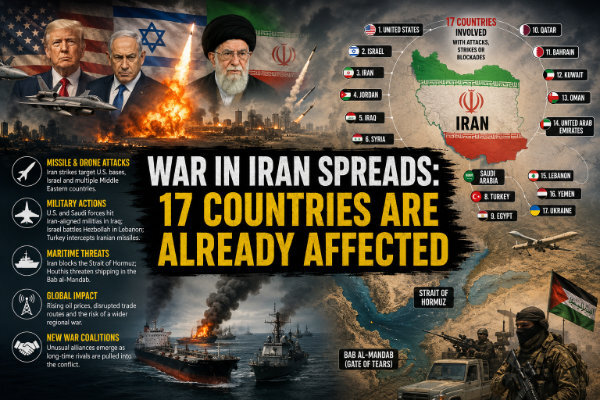
By a broad count, at least 17 countries have now been directly attacked, involved in military operations or pulled into closely connected confrontations: the United States, Israel, Iran, Jordan, Iraq, Syria, Saudi Arabia, Qatar, Bahrain, Kuwait, Oman, the United Arab Emirates, Turkey, Egypt, Lebanon, Yemen and Ukraine.
That does not mean all 17 nations have officially declared war. Some are active combatants, while others host American bases, have intercepted Iranian missiles, suffered damage from attacks or become part of expanding maritime and proxy conflicts.
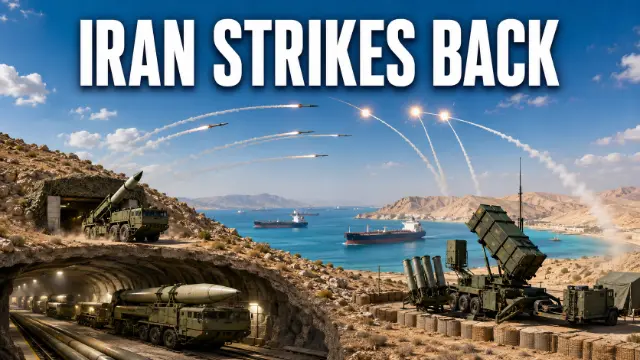
The original confrontation involved the United States, Israel and Iran. Tehran responded to American and Israeli strikes by targeting Israel and American military installations across the Gulf and the wider Middle East. Iranian missiles and drones have been launched toward bases or facilities in Jordan, Bahrain, Kuwait, Qatar, Oman and Syria. Saudi Arabia and the United Arab Emirates have also faced attacks or damage to important oil, gas and transportation infrastructure.
Turkey, a NATO member, has intercepted Iranian ballistic missiles entering or approaching its airspace. NATO has so far avoided treating the incidents as an attack on the entire alliance, but every missile crossing Turkish territory increases the danger of a confrontation involving additional countries.
The conflict widened again when American and Saudi aircraft jointly struck Iran-aligned militia positions in Iraq. Iraq condemned the operation as a violation of its sovereignty and insisted it had not approved the attacks. Iran later launched another barrage toward American forces in Jordan, prompting fresh U.S. strikes against Iranian military targets.
Egypt has also been touched by the violence. A drone attack struck gas-related vessels at the Mediterranean port of Damietta, causing fires and raising fears that the conflict could move closer to the Suez Canal. Responsibility for the attack remained unclear, but the incident demonstrated how rapidly uncertainty itself can become dangerous during wartime.
Meanwhile, Israel’s continuing confrontation with Iran-backed Hezbollah has brought Lebanon deeper into the wider battlefield. In Yemen, the Iran-aligned Houthis have threatened Saudi interests and shipping near the Bab el-Mandeb, creating another front beside one of the world’s most important maritime routes.
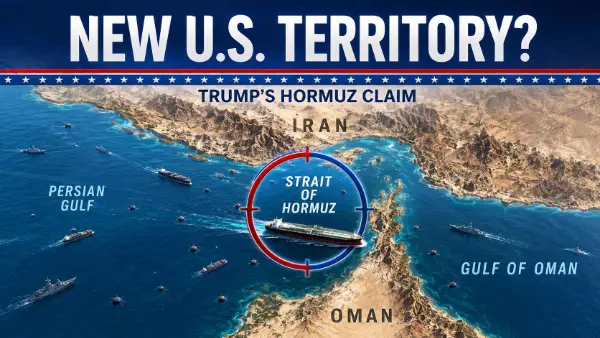
The Strait of Hormuz remains the most serious economic pressure point. Iran has stopped, inspected or turned back vessels while shipping traffic continues under unstable conditions. Roughly one-fifth of the world’s oil normally passes through the strait, meaning even a partial disruption can raise fuel and transportation costs far beyond the Middle East.
The war has even reached the Caspian Sea. Iran accused Ukraine of attacking an Iranian commercial vessel, while Kyiv has said it targeted vessels involved in transporting Iranian-linked military equipment to Russia. Ukraine has also accused Moscow of supplying Tehran with satellite imagery of American bases in Bahrain, Jordan and Kuwait.
The connection between the wars in Ukraine and Iran may be the clearest warning sign. Russia and Iran already cooperate militarily, with Iranian weapons supporting Moscow’s campaign in Ukraine and Russian intelligence reportedly assisting Tehran with information about potential targets in the Middle East.
New and unusual military partnerships are also emerging. American and Saudi forces have operated together against Iran-aligned militias, while regional governments that once tried to remain outside the confrontation are being forced to defend their airspace, ports, energy facilities and shipping lanes.
For President Donald Trump, the room for maneuver appears to be narrowing. Prolonged military operations place pressure on American weapons supplies, while high oil prices threaten consumers and the broader economy. At the same time, repeated Iranian attacks make it politically difficult for Washington to step back without appearing to accept defeat.
That combination creates a dangerous cycle. Iran attacks, the United States and Israel retaliate, and each new round expands the battlefield or pulls another country into the crisis.
World wars do not necessarily begin with a formal announcement. They can develop through alliances, miscalculations, proxy forces and retaliatory attacks that gradually draw additional governments into the fighting.
The world has not reached that point. Russia, China and NATO are not openly fighting one another across several continents, and diplomatic efforts have not completely ended.
 News Staff
 -
-
World at War
World at War
17 countries involved
-
489 views -
0 Comments -
0 Likes -
0 Reviews
-
-
World at War
World at War
17 countries involved
-
489 views -
0 Comments -
0 Likes -
0 Reviews




 Loading ...


